
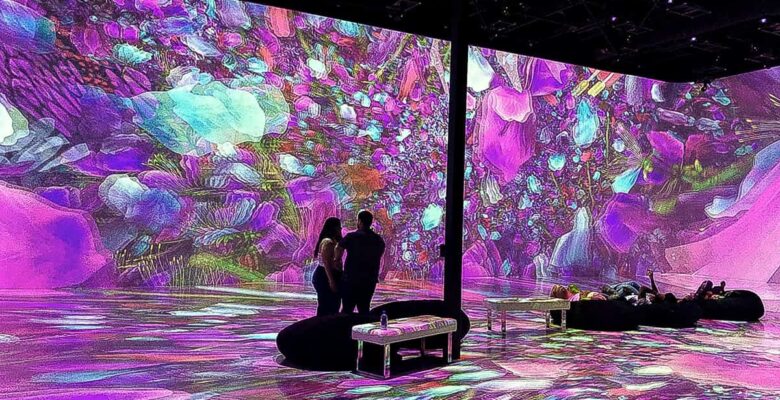
Two of Houston’s newest art attractions are cutting-edge, experiential and technology-driven. Designed for an urban young-adult audience, you might think. But when I explored Artechouse and Meow Wolf Radio Tave, I quickly took note of the visitor diversity.
Teens arrived in groups of a half-dozen or so. Parents pushed their toddlers in strollers. Elementary students came on outings with grandparents. And a self-described old hippie from Orlando told me he was reveling in everything “cosmic” at Meow Wolf.
This article contains affiliate links. We earn from qualifying purchases.
Artechouse (shown above) has been around since 2015 and opened its Houston location in 2024. Houston was the fifth city chosen for a themed Meow Wolf, which also opened last year.
Artechouse describes itself as an intersection of art, science and technology where “curiousity-seekers of all ages go to experience creative innovation without limits.” Its high-resolution digital projections fill the exhibit spaces, as does the music.

Meow Wolf installations are more tangible, designed by technologists, writers, fabricators, graphic designers, painters, sculptors and musicians. One reviewer described it as “equal parts scavenger hunt, escape room, dance party and interactive museum.”
Founded in Santa Fe, Meow Wolf also has locations in Grapevine, Denver and Las Vegas. Artechouse previously opened in Washington, D.C., New York City and Miami.
Both experiences are energizing yet somehow soothing. The lights are dim. Visitors tend to soak it all within doing a lot of talking. There are ample places to sit and rest and ponder what’s before you. Artechouse even has bean-bag chairs.
Another first for Houston is coming Sept. 18-21, when Miami’s Untitled Art fair will grace the George R. Brown Convention Center. Described as a “boutique invitational art fair,” it will feature contemporary works from galleries throughout Texas and across the globe.
Trust me on this. The Houston Museum of Natural Science is not to be missed. If there’s anything you love that’s beneath, on or above the earth, this amazing institution has an exhibit just waiting for you.
I started with the glass-domed Cockrell Butterfly Center, and I didn’t want to leave. It’s a three-story rainforest complete with the soothing sounds of a 50-foot waterfall. It even smells heavenly, thanks to the flowering plants that provide nectar for the 1,500 butterflies that call the center home.
There’s a laminated guide available to help you identify the dozens of species, which range from the giant magnificent owl to the vibrant orange emigrant to the delightful African moon moth.
Auditorium experiences include the Burke Baker Planetarium and the Wortham Giant Screen Theatre, which is currently showing the world premiere of the holographic “Dinosaur Discoveries.”
“Audubon’s Birds of America” is a touring exhibition from National Museums Scotland that showcases 46 prints from their collection. The exhibit tells the story of how Scottish publishers and scientists were the first to properly recognize the beauty and genius of the ornithological illustrations of John James Audubon. We’ve all seen Audubon’s work adorning calendars, teacups and coffee-table books. But to view up-close the giant original prints is another thing altogether.
If gems are your thing, you can explore the artistry of Carl Fabergé, the jeweler who created for the Russian aristocracy the first Faberge Egg, then move on to the Cullen Hall of Gems and Minerals.
Carl Fabergé’s brilliance lay not only in crafting imperial treasures but in elevating everyday items into works of art, the exhibition explains. From household gadgets to vanity pieces, he infused luxury and elegance into the ordinary.
From an amethyst weighing more than 850 pounds to a crystallized gold cluster that is one of the most highly-coveted objects in the mineral kingdom, the specimens on display in the Cullen Hall of Gems and Minerals are “the Rembrandts and Picassos of the natural world,” museum curators say.
The dazzling collection of more than 450 crystallized mineral specimens includes some of the world’s most rare and beautiful examples, which you can examine from all angles in display cases illuminated by fiberoptic lighting.
Other exhibitions include the Hall of African Wildlife, the Hall of Ancient Egypt and the Hall of the Americas. The Hall of Malacology is everything you ever wanted to know about mollusks.
Your fellow visitors represent the countries of the world at Space Center Houston, the visitor center for NASA Johnson Space Center and the city’s top attraction for international tourists.
One of the narrated tram tours takes you to a gallery overlooking a restored Mission Control, from which NASA led the Gemini and Apollo missions. Thanks to vintage footage, you can re-live July 20, 1969, the day Neil Armstrong and Buzz Aldrin landed on the moon in the Lunar Module Eagle. Our group applauded as the presentation ended.
By Kimberly Burk
Guest Author

Leave a Reply