
My dog used to drool through an entire seven hour drive to my parents’ house. Not a little. A puddle on the seat kind of drool, followed by a full refusal to lie down. I spent three summers blaming the destination before I finally admitted the problem started about forty seconds after the engine turned over.
If that sounds familiar, you probably already know that the road trip itself is the hard part, not the arrival. Families heading out with pets in tow plan routes, pack snacks, and book pet friendly stops. The bit that gets skipped is the hour in the car when your dog is convinced something is wrong. So I built a kit for it, and I’ll show you exactly what goes in yours. Some owners also keep a quiet-support product packed alongside the chew toys, and many land on organic CBD for Canine options for exactly this reason. Whether you go that route or not, the packing logic below holds either way.
This article contains affiliate links. We earn from qualifying purchases.
Why the car turns a calm dog into a nervous one
Motion, engine noise, and the sight of familiar streets sliding past at speed hit a dog differently than they hit you. Your dog can’t read a map. It has no idea the ride ends somewhere good. Every bump reads as a small unknown event.
Puppies who missed out on short rides during their early months tend to carry that gap into adulthood. So do rescues with a rough transport history. Recognizing where the nerves come from matters, because it tells you which tool to reach for. A dog who panics at the sound of the garage door needs a different plan than a dog who’s fine until mile ninety.

Build the kit around the first ten minutes, not the whole trip
Here’s the mistake I made for years: I packed for the destination. Toys, bowls, a bed, treats for the other end of the drive. Then I’d shove it all in the hatch and hope. The exact wrong order.
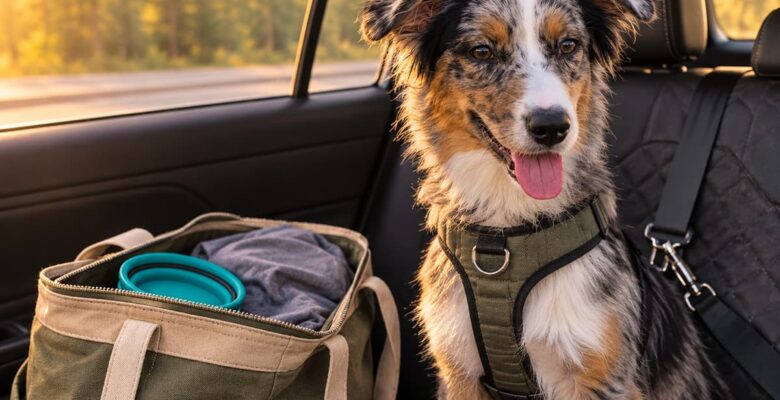
Your dog’s stress peaks in the first stretch. Pack for that window. I use a soft-sided tote with a zippered top so nothing spills, and I keep it on the back seat where I can reach it at a red light without unclipping a seatbelt.
- A worn t-shirt of yours, unwashed, sealed in a zip bag until you need it
- Two high-value chews your dog only ever gets in the car
- A collapsible water bowl and a bottle you can pour one-handed
- A towel. Not for spills. For wiping a nervous dog’s paws and face, which settles them
- Any calming support you’ve already tested at home, in its original labeled container
The shirt trick is the one people skip and the one that works fastest. Familiar scent does more for a nervous dog on the road than any gadget I’ve bought.
The Three-Mile Test, and why you should run it before any long drive
This is the piece I’d fight for. Before you commit to a five hour trip, run what I call the Three-Mile Test. Drive three miles from home, turn around, come back. That’s it. No errand, no destination, no reward at the end.
What you’re watching for is a baseline. Does your dog settle by mile one or stay rigid the whole way? Does drooling start at the door or later? If the first three miles are rough, a longer drive won’t fix it. If they’re smooth, you’ve got your answer.
Run the test on a normal day, not the morning of your trip. Run it once with the kit on the seat and once without. You’ll learn more from two short drives than from a hundred forum posts, because that data is about your dog specifically. According to the American Veterinary Medical Association, travel anxiety is a common concern vets hear about, and behavior changes on short trips are worth tracking and sharing with your vet. So track them. Note the time, the distance, and what your dog did.
What to pack for the humans, since you’re riding with a nervous animal
You can’t calm a dog if you’re stressed. I learned to pack for myself too, and it changed the drive. A spare shirt in the front seat. A playlist you can actually tolerate on repeat. A route with one planned stop where you can walk your dog in a quiet corner of a rest area instead of a crowded truck stop aisle. The American Automobile Association recommends planning rest stops in advance on long drives, and for pet owners that advice earns its keep.
Timing beats almost everything else
Leave at a time that matches your dog’s low-energy window. For most dogs that’s early morning, before the neighborhood wakes up and before the heat climbs. If your dog is a night owl, a late evening start will be calmer than a noon departure, even if it’s inconvenient for you.
Feed a lighter meal a couple hours before you leave. A full stomach plus a moving car is a rough combination, and you’ll be the one cleaning the back seat. Skip the big breakfast. Save the good treats for the road.
When to bring your vet into the conversation
There’s a line between a dog who dislikes the car and a dog who’s genuinely suffering. If your dog pants hard, paces, or can’t settle for a full hour, that’s worth a call. Your vet can rule out anything physical and talk through options, including calming products and pheromone sprays. I’m not a vet and I won’t pretend to be, but I will say this: the owners who bring it up early tend to have easier trips than the ones who white-knuckle it for years.
And if you’re trying a calming support product for the first time, test it at home on a normal day first. Never debut a new supplement on the morning of a long drive. That’s not caution, that’s just common sense.
Pack the kit, run the test, then go
Your dog doesn’t need a perfect trip. It needs a predictable one. Build the tote, run the Three-Mile Test, pick your departure window, and give your vet a heads up if the nerves run deep. Do those four things and the drive stops being the worst part of the trip.
So, what’s in your kit right now? Pull it out, dump it on the floor, and count how many items are actually for the first ten minutes. That number tells you whether you’re packed for the journey or just for the destination.

Leave a Reply