
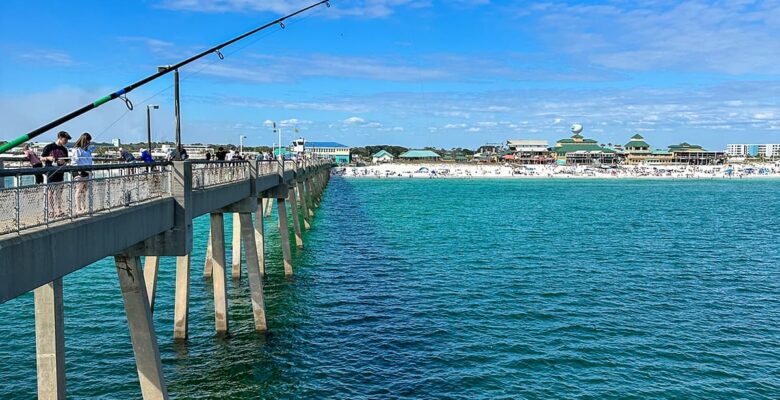
My father took me fishing in the White Mountains of Arizona when I was small. I remember the cold of the morning. The smell of the water. The particular silence that happens when two people are fully present with each other and don’t need to fill it. I remember feeling like I was being let in on something important about the world.
Years later, I took my three children fishing in Oklahoma. Same principle, different water. We spent hours out there and sometimes came home empty-handed. We didn’t cared. That’s the whole point of fishing, if you’re doing it right, it was never really about the fish.
This article contains affiliate links. We earn from qualifying purchases.
So when I went to Pensacola to visit my eldest son, I invited him to spend a day with me in nearby Destin/Fort Walton Beach, Florida. I knew exactly what we were doing and why. We were choosing, again, to spend our time on an experience rather than a thing. To be somewhere together, fully, with our hands in the world and our phones in our pockets.
What I didn’t fully anticipate was how perfectly the Gulf Coast would honor that intention from the pier all the way to the plate.

Why Destin/Fort Walton Beach Is Built for This
Destin calls itself the “World’s Luckiest Fishing Village,” and that reputation is earned. The town sits over a natural pass where the Gulf of Mexico meets Choctawhatchee Bay, creating one of the most productive fishing grounds on the Gulf Coast. The water runs that impossible emerald green, and beneath it, red snapper, grouper, amberjack, and mahi-mahi have supported generations of fishing families. This is not a beach town that happens to have seafood on the menu. It is a fishing town that happens to have a great beach and the difference shows in everything from the restaurants to the rhythm of the harbor at dawn.
Gavin and my other two children grew up knowing that experiences outlast things. It’s a value we’ve built our relationship on, the four of us. More road trips than souvenirs, more mornings doing something than afternoons at the mall. He showed up ready, the way he always does when there’s water involved and a plan worth following.
Hours on the Pier, Nothing in the Net
We started at the Island Pier in Fort Walton Beach, because that’s where this story has to begin.
Pier fishing is the most democratic version of the sport. No boat, no license required, no expertise demanded. You show up, pay a small daily fee, you drop a line, and you let the Gulf do what it wants. If you don’t have a rod/reel, then you can rent one for the day.
The pier area puts you directly over productive water. This isn’t ornamental fishing. The Gulf provides, when it decides to. That day, it decided not to. We spent hours out there, working the line, watching the water, trading theories about why the fish were elsewhere. We caught nothing. Not a single thing.
And it was one of the best afternoons I’ve had in recent memory.
There’s a conversation that only happens when you’re standing next to someone with nowhere to go and nothing to do but wait. We talked about his life in Pensacola, about the things he’s building, about the fishing trips we took in Oklahoma. He still remembers those trips the way I remember Arizona. It’s not the catch, but the quiet and the sense of being somewhere that mattered. Three generations of empty nets and full mornings. My father would have approved.
The pier also does something specific for families with teens that I’ve been thinking about ever since: it removes the performance pressure from travel. Nobody is watching you fish. Nobody cares if you’re good at it. There are no scores, no rankings, no Instagram moment to manufacture. You are just a person standing over the Gulf of Mexico, and that is enough. In a world that constantly asks teenagers to perform, the pier asks them to simply be. That’s rarer and more valuable than it sounds.
Harbor Docks: Where the Gulf Becomes Dinner
By the time we walked into Harbor Docks for an early dinner, we had earned our hunger.
Harbor Docks has been on the Destin Harbor since 1979. It’s not a tourist concept, but a genuine working institution rooted in this fishing community. Eddie Morgan, who owns it today, grew up on these docks. His father Charles started it as a deckhand, bought a small harbor property, put out picnic tables, and started shucking oysters. The family-owned seafood market next door still supplies the restaurant with Gulf-caught fish that’s inspected, processed in-house, and simply prepared. Over 90% of seafood served in Florida is imported. At Harbor Docks, you can watch the boats unload on the dock out back. The supply chain is so short it almost feels radical.
Executive Chef Duster Strawbridge is the person who translates that philosophy into what arrives at the table, and his approach reflects someone who has cooked next to extraordinary ingredients long enough to respect them deeply.
“When you have access to beautiful Gulf fish,” he told me, “it would be silly to cover it up.”
That restraint is rarer and harder than it sounds in a culinary culture that too often mistakes complexity for quality.
What We Ate and Why It Mattered
Before we even looked at the menu, I noticed the detail that ties this whole experience together: Harbor Docks offers a Hook & Cook option. Bring in your fresh catch from a charter or the pier, and the kitchen will cook it for you. It’s the most literal farm-to-table arrangement you’ll encountered, and it makes the pier-to-plate story feel less like a metaphor and more like an actual option families can plan around. If we’d caught anything that day, we would have handed it straight to Chef Duster. Next time, that’s the plan.
We started with the smoked fish dip and house-made chips, which is the right place to start at Harbor Docks. The dip is house-smoked and texturally perfect. The chips are made in-house and have the kind of honest crunch that tells you nobody cut a corner. It was the kind of first course that sets the tone for what a kitchen actually cares about.
Then sushi, because Harbor Docks has been quietly one of the best sushi bars on the Gulf Coast since Chef Yoshie Eddings joined in the early 1990s, before sushi was mainstream in most of the American South. The restaurant helped change that by making it approachable alongside its seafood menu, and the bar has been a cornerstone ever since.
For the main, Gavin went with the blackened swordfish, which arrived with a crust that had real heat and char to it and fish underneath that was meaty and clean. I had the seafood platter, a generous spread that let me work through the Gulf’s greatest hits and appreciate how different truly fresh seafood tastes from what most people accept as the standard. Everything tasted exactly like where it came from.
We sat inside with a full view of the harbor. A pelican staked out a piling nearby, a charter boat came in with a flag flying that meant a good day on the water. Somewhere in the gap between our empty-handed morning on the pier and this table full of Gulf seafood, something had come full circle. We hadn’t caught anything. And somehow the meal felt more connected to the water, to the fishing, to the whole story of this place, than if we had.
That’s the thing about Harbor Docks. It completes the sentence that the pier starts.
What This Kind of Day Teaches
I’ve been writing about family travel for a long time, and I keep coming back to the same question: what actually reaches kids? What cuts through the noise and lands as a real memory, the kind they’ll carry forward and eventually pass on?
The answer, consistently, is experiences that have a narrative arc. A beginning, a middle, and an end that means something. A day that makes sense from first light to last bite.
The pier-to-plate experience in Destin/Fort Walton Beach has that structure. There’s the anticipation of the morning, the patience and presence of the pier, the earned hunger, and the reward of a meal that grew directly out of the place you spent the day. Families with teens, especially teens who’ve grown up in a world of instant gratification, respond to that arc. They respond to doing something real, even when the something real doesn’t produce a measurable result.
We caught nothing and remember everything. That’s exactly how my father would have described Arizona, if you’d asked him.
Plan Your Cast, Catch, Cook Day in Destin
The Island Pier: Head to Fort Walton Beach pier area for access. No fishing license is required for pier fishing in Florida. Gear is available onsite, making this fully accessible for first-timers and families who have never fished before. Nearby parking is free.
Harbor Docks: 538 Hwy 98 E, Destin, FL 32541. Open Sunday–Thursday 11am–10pm, Friday–Saturday 11am–11pm. No reservation system, so arrive early or embrace the wait. Start with the smoked fish dip and house-made chips. Order what came off the dock that morning. Sit outside if you can.
Best Time to Visit: Shoulder season, March, October, early November means lighter crowds, more candid access to locals and chefs, and the same emerald water without the summer wait times.
The Most Important Thing to Pack: Leave the agenda loose. The pier teaches patience whether you mean it to or not, and Harbor Docks rewards presence. This is not a day to rush. This is a day to be in.
A special thank you to the Destin Fort Walton Beach tourism office for hosting our fishing experience and dinner at Harbor Docks. As always, all opinions and soggy fishing stories are entirely my own.

Leave a Reply